
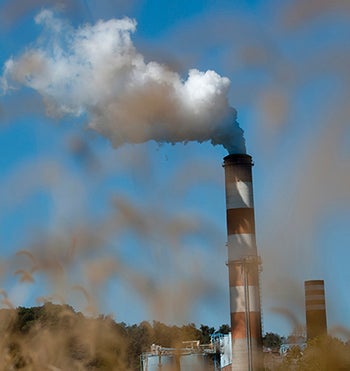
Computer processing demands for artificial intelligence (AI) are driving an alarming increase in deadly air pollution from power plants and backup diesel generators, which are essential for supplying electricity to the growing number of computer processing centers across the United States.
This surge in air pollution is projected to cause as many as 1,300 premature deaths annually by 2030. The total public health costs, encompassing expenses related to cancers, asthma, and other health issues, as well as lost work and school days, are nearing an estimated $20 billion per year.
These findings emerge from a recent study conducted by scientists from UC Riverside and Caltech, which highlights a concerning oversight within the tech industry regarding these human and economic costs.
Shaolei Ren, an associate professor at UC Riverside and a principal author of the study, noted, ‘If you look at those sustainability reports by tech companies, they only focus on carbon emissions and sometimes water usage, but there’s absolutely no mention of unhealthful air pollutants, which are already creating a public health burden.’
The researchers, including Caltech professor Adam Wierman, are advocating for the adoption of standards that would require tech companies to disclose the air pollution generated by their power usage and diesel generators.

Moreover, the study also proposes that communities disproportionately affected by air pollution from data processing centers receive adequate compensation from tech companies for the associated health burdens.
Ren highlighted that the effects of air pollution from AI operations disproportionately impact low-income communities, primarily due to their proximity to power plants or backup generators at data processing facilities. These pollutants do not respect local boundaries, affecting communities across county and state lines.
‘The data centers pay local property taxes to the county where they operate,’ Ren stated. ‘However, the health impacts are not limited to a small community; they travel across the entire country, leaving other areas uncompensated.’
For instance, pollution from backup generators at data centers in Northern Virginia affects states like Maryland, West Virginia, Pennsylvania, New York, New Jersey, Delaware, and even the District of Columbia, resulting in regional public health costs estimated between $190 million to $260 million annually. Should these generators emit at maximum permitted levels, the costs could skyrocket to between $1.9 billion and $2.6 billion each year.
In fact, the public health expenses tied to AI processing centers in some regions could surpass the electricity costs that tech companies incur.
As tech companies accelerate their efforts to deliver AI services that are transforming numerous industries, the resulting air pollution, particularly in the form of fine particles smaller than 2.5 micrometers and regulated pollutants like nitrogen oxides, is anticipated to rise significantly. By 2030, the public health burden from this pollution could surpass that associated with the U.S. steel-making industry and rival that of vehicular emissions in California, according to the study.
‘The growth of AI is driving an enormous increase in demand for data centers and energy, making it the fastest-growing sector for energy consumption across all industries,’ Ren explained.
Ren and his colleagues evaluated the emissions from the training phase of large language models (LLMs), specifically Meta’s Llama-3, which was launched in July. The analysis highlighted that the electricity required for training this model generates air pollution equivalent to more than 10,000 car trips between Los Angeles and New York City.
The authors utilized statistical methods developed by the U.S. Environmental Protection Agency to estimate health costs related to premature deaths. The forecasted 1,300 annual deaths by 2030 represents a midpoint within a range of 940 to 1,590.
‘If you have family members with asthma or other health conditions, the air pollution from these data centers could be affecting them right now. It’s a public health issue we need to address urgently,’ said Ren.
The study is titled ‘The Unpaid Toll: Quantifying the Public Health Impact of AI.’ In addition to Ren and Wierman, the team includes Yuelin Han, Zhifeng Wu, and Pengfei Li, all from UCR’s Bourns College of Engineering. This research builds on Ren’s earlier findings that raised awareness of AI’s significant water consumption footprint.


- 0 Comments
- Air Pollution
- Environmental Impact
- Public Health