
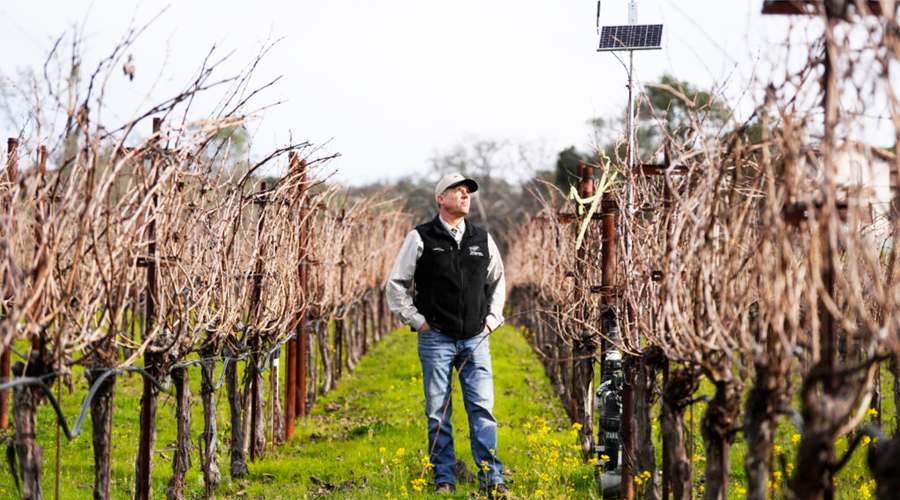
LOS ANGELES (AP) — In the world of viticulture, artificial intelligence (AI) is paving the way for innovative farming practices. When AI-enhanced tractors entered the market, Tom Gamble, a third-generation farmer from Napa Valley, was quick to adopt this groundbreaking technology. Gamble recognized the potential benefits, despite the learning curve that accompanies any new tool.
Currently utilizing his autonomous tractor’s AI sensor, Gamble is mapping out his vineyard in Napa Valley. The tractor’s AI module processes the data it collects, enabling Gamble to make better-informed decisions regarding crop management, a strategy he refers to as “precision farming.”
He noted, ‘It’s not going to completely replace the human element of putting your boot into the vineyard, and that’s one of my favorite things to do. But it’s going to be able to allow you to work more smartly, more intelligently and in the end, make better decisions under less fatigue.’
Gamble anticipates wide application of this technology due to its economic advantages and the potential for reducing pollution and fuel consumption.’
Experts agree that the integration of AI in the wine industry serves as a testament that businesses can leverage technology to enhance labor efficiency without displacing human workers. AI technologies can help farmers minimize waste, optimize water use, and effectively manage pest control. AI-powered tractors and irrigation systems analyze soil conditions, streamlining vineyard management with accurate health data and yield predictions.
Beyond vineyard equipment, the wine industry also embraces generative AI for creating unique wine labels and even developing pricing strategies with the assistance of platforms like ChatGPT.
Contractor Sean Sundberg from John Deere explained that their ‘Smart Apply’ technology employs AI to ensure precise application of materials by utilizing sensors to determine where vines require treatment. Last year, John Deere collaborated with Sonoma County Winegrowers to maximize yield through technology-enhanced farming.
Tyler Klick from Redwood Empire Vineyard Management stated his company is automating irrigation systems which intelligently monitor water usage and detect leaks. Klick mentioned, ‘That valve is actually starting to learn typical water use. It’ll learn how much water is used before the production starts to fall off.’
Investments in AI are not without skepticism, particularly among smaller vineyards. Angelo A. Camillo, a professor at Sonoma State University, highlighted that about 80% of the wine industry in America comprises small family-owned operations, many of which lack the financial resources to invest in AI technology. He elaborated on the disparity: ‘For small wineries, there’s a question mark, which is the investment. Then there’s the education. Who’s going to work with all of these AI applications? Where is the training?’
Despite challenges such as scalability and the need for technical expertise, AI has been praised for its capacity to monitor crop health and forecast yields, thereby providing farmers with vital data to enhance production efficiency. Mason Earles from UC Davis stated, ‘Predicting what yields you’re going to have at the end of the season, no one is that good at it right now.’
Ultimately, the integration of AI technology into vineyards offers great potential for enhancing the sustainability of the wine industry. As Gamble succinctly remarked, ‘Farmers, Gamble said, are always evolving.’ With each technological era, farmers have adapted, proving that advancements in farming cultivate richer landscapes and improved yields.


